
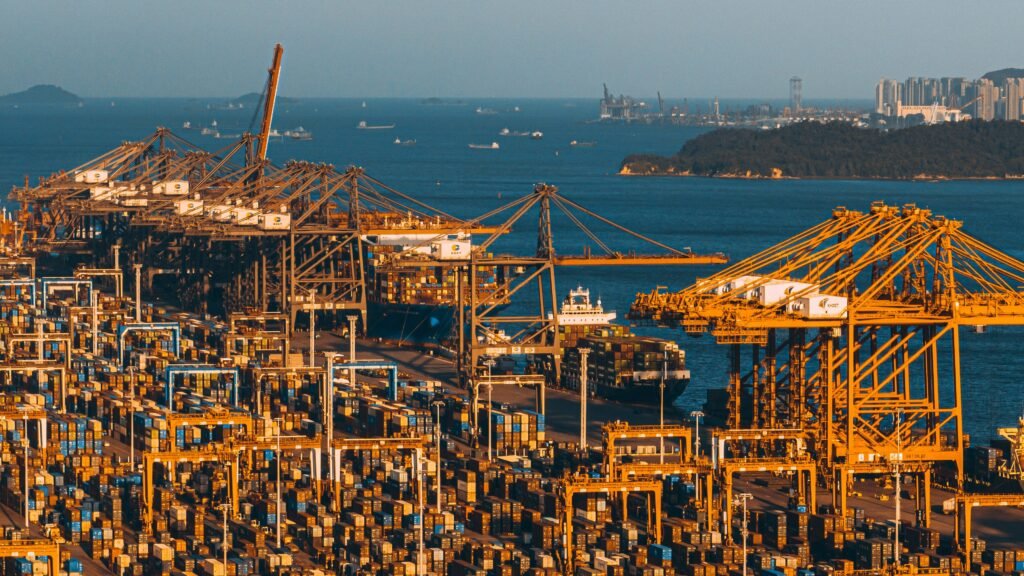
Georgia occupies a structurally strategic position between Europe, Central Asia, and the Middle East, functioning as a natural bridge between these regions rather than a large domestic consumption market. This geography underpins its long-term value as a logistics and transport hub.
The country’s role is anchored in two primary transit axes. The East–West corridor (Middle Corridor) connects China and Central Asia with Europe via the South Caucasus and Turkey. This route has gained structural importance as global supply chains diversify away from northern routes, increasing reliance on Black Sea access points such as Poti and Batumi. Cargo volumes along this corridor are increasingly driven by intermodal rail–road–sea integration.
The North–South corridor links Russia, Armenia, Iran, India and Azerbaijan through Georgian territory. While more exposed to geopolitical volatility, it remains an active route for regional trade and energy-related logistics flows, reinforcing Georgia’s position as a multi-directional transit platform.
Georgia’s logistics system is built on four integrated layers: road freight (primary domestic and regional mode), rail infrastructure (key connector between inland corridors and ports), maritime gateways (Poti and Batumi on the Black Sea), and a parallel infrastructure layer of pipelines and digital networks. This multi-layer configuration creates a structural advantage for intermodal logistics development.
According to the National Bank of Georgia and GeoStat, transport and logistics activity is closely correlated with external trade volumes and foreign capital inflows, making the sector directly exposed to global trade cycles while benefiting from regional rerouting trends. Recent years have shown sustained growth in transit freight and infrastructure utilization, driven by increasing Asia–Europe trade flows and supply chain reconfiguration.
Despite this growth, the system remains under-optimized. Key constraints include limited rail capacity, port handling efficiency, and fragmented multimodal integration. These constraints are not structural limitations, but rather value creation gaps in the logistics chain.
Investment opportunity
The core investment thesis in Georgia is not market demand, but infrastructure efficiency capture and corridor optimization.
Priority investment areas include:
- expansion and modernization of rail freight capacity and rolling stock
- port capacity upgrades and terminal efficiency improvements (Poti, Batumi)
- development of logistics hubs, dry ports, and bonded warehousing
- modernization of road freight fleets and last-mile logistics systems
- customs digitalization and border throughput acceleration
- integrated multimodal platforms linking rail, road, sea, and digital logistics systems
Demand is not speculative. It is already embedded in Asia–Europe trade flows, which are actively diversifying due to geopolitical shifts, cost optimization pressures, and route redundancy strategies.
In structural terms, Georgia is already functioning as a transit corridor. The investment opportunity lies in transitioning it from a pass-through system into an optimized logistics platform, capturing value through efficiency gains, infrastructure upgrading, and logistics services development.
As global supply chains continue to fragment and re-route, Georgia’s geographic position provides a non-replicable advantage. Unlike policy-driven incentives or short-term market cycles, this advantage is structural and persistent, making logistics infrastructure investment in Georgia a long-duration, corridor-based opportunity.